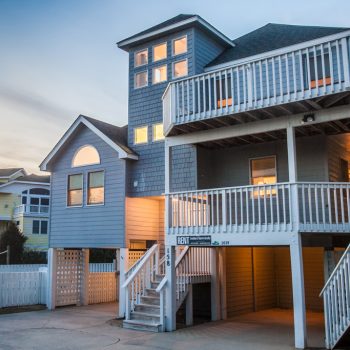
In practical terms, a good OBX rental property is one that fits the right town, attracts the kind of guests that area consistently draws, and still makes sense after you model the expenses honestly. The strongest investors do not just ask how much a home might gross. They ask how stable demand is, what features actually drive bookings, and whether the property still works once the real costs are added back in.
If you are evaluating a property for vacation-rental use, start with the market and the town before you fall in love with the house. In the Outer Banks, rental potential is shaped as much by where the property sits and how it fits guest demand as by the home itself.
Start With Market Demand and Town Fit
Before you look at a specific property, you need to understand the broader rental environment. The Outer Banks Visitors Bureau maintains statistical resources for the region, and OBX tourism reporting continues to frame the area as a major visitor market with strong economic reliance on travel demand. North Carolina State University also cited $2.7 billion in tourism spending across OBX counties in 2023, which helps explain why town-level demand patterns matter so much when evaluating vacation-rental potential. See the Outer Banks statistics resources and NCSU’s tourism summary on Outer Banks tourism resilience.
That said, the OBX is not one uniform rental market. A property in Nags Head does not compete the same way as a property in Corolla or a home farther south on Hatteras Island. Some towns pull more family beach demand, some lean more heavily on larger vacation groups, and some are more sensitive to access, amenities, or seasonality. To understand how location affects value as well as booking appeal, review what affects home value in the Outer Banks.
Evaluate the Property Like a Guest Would
Once the town makes sense, shift to the property itself. Bedroom count, bathroom count, layout, parking, beach access, outdoor gathering space, pool or hot tub potential, pet-friendliness, and whether the home works well for extended family groups all shape rental appeal. A home does not need to be luxurious to perform, but it does need to match what guests expect in that town and price tier.
This is where investors often make avoidable mistakes. They buy based on personal taste instead of guest usability, or they overvalue features that do not meaningfully change occupancy. In the Outer Banks, layout and function matter. If the home is awkward for a group stay, hard to access, short on parking, or too limited on outdoor living, the property may underperform even if the address sounds promising. For a broader view of how buyer decisions should align with property fit, see buying Outer Banks real estate.
Use Town Context, Not Just Regional Averages
Rental potential by town matters because guest expectations and booking patterns change across the Outer Banks. A home in a central market such as Nags Head or Kill Devil Hills may benefit from broad appeal and easier access, while a home in Duck or Corolla may need to justify its performance through a different mix of setting, amenities, and use pattern. The right question is not just whether OBX rentals are strong overall. It is whether this specific property fits the type of guest demand that its town tends to support.
That is why broad market optimism is not enough. Regional overviews can help you understand the macro picture, but town-level performance and local competition are what shape the deal. If you are comparing town-specific fit, your property evaluation should look at beach orientation, surrounding inventory, access patterns, and how the home compares to the most bookable nearby alternatives. As one town-level starting point, see Nags Head real estate.
Model Income Realistically
Once the property and town pass the initial fit test, the next step is income modeling. This means estimating occupancy, average daily rate, shoulder-season softness, and how much of the calendar is actually usable for revenue. A rental projection can be helpful, but it should be treated as a scenario tool, not a promise.
Strong investors compare best-case, likely-case, and conservative-case performance. They also compare the property to real booking behavior in its market segment rather than assuming the highest visible rates are normal. Gross revenue can look impressive in isolation, but it only becomes meaningful once it is tied to realistic calendar use and a matching expense model. For a broader framework on this type of ownership, review the OBX vacation rental investment guide.
Focus on Net Income, Not Just Gross Revenue
The most common mistake in OBX rental analysis is stopping at gross rental potential. A property may show appealing seasonal revenue and still disappoint as an investment once you account for management fees, cleaning, turnover, utilities, internet, pool or hot tub service, supplies, repairs, insurance, taxes, and reserve needs.
Net performance is what matters. That means asking what is left after the routine costs of operating the property the way guests expect it to be operated. If the property only works under aggressive occupancy assumptions or if the margin disappears after insurance and maintenance are added, the rental potential is weaker than the headline number suggests.
Do Not Underestimate Management and Operations
For many out-of-area investors, management is not optional. It is the operating backbone of the asset. The quality of the local management setup affects guest response time, turnover consistency, maintenance coordination, owner reporting, and ultimately repeat booking potential. A weak management setup can drag down a property that otherwise should perform well.
This is especially important in a market where turnover logistics, contractor coordination, and storm-season readiness can affect both guest experience and long-term maintenance. If you are evaluating a property as a rental, review what professional oversight actually includes and what it costs on the Outer Banks property management page.
Insurance, Flood Risk, and Coastal Exposure Can Change the Deal
In the Outer Banks, risk is part of the investment analysis. Flood exposure, storm vulnerability, elevation context, shoreline conditions, and the resulting insurance burden can materially change the property’s real performance. Two homes with similar purchase prices and similar booking appeal can create very different owner outcomes once insurance and upkeep are factored in.
North Carolina’s Flood Risk Information System provides flood hazard data and maps that can help buyers understand this side of the equation before closing. You should also evaluate how coastal wear may affect future repairs, deferred maintenance, and guest perception over time. Use the North Carolina Flood Risk Information System alongside local due diligence. On the property side, it also helps to review home inspections when buying in the Outer Banks.
Check the Tax and Use Rules Early
Tax treatment matters, especially if the property may have some owner use. The IRS explains that if you use a dwelling unit as a residence and rent it for fewer than 15 days during the tax year, you generally do not report the rental income and do not deduct rental expenses as rental expenses. If the home is used for both rental and personal purposes, expenses generally must be allocated between the two based on days of use, and deductions can be limited by gross rental income rules. See IRS Topic No. 415 for the baseline rule.
This matters because many OBX buyers are not purely passive investors. They may want some owner use, and that changes how they should think about income, taxes, and what “rental potential” really means in practice. A property can be attractive as a hybrid use asset, but the analysis needs to reflect that honestly rather than treating every property like a pure STR play.
Stress-Test the Downside Before You Buy
A good rental evaluation should always include a downside test. What happens if bookings soften, insurance rises, a storm season increases repair needs, or a property needs more updates than expected to stay competitive? A home that only works in a perfect year is not a strong investment framework.
The better approach is to ask whether the property still makes sense under more conservative assumptions. If the answer is yes, the rental potential is probably more durable. If the numbers only hold under peak assumptions, the property may be better as a lifestyle purchase than as an investment decision.
Due Diligence Checklist
- Confirm the town-level demand pattern and who typically rents in that area.
- Compare the property’s bedroom count, layout, parking, and amenities to nearby competing rentals.
- Use realistic occupancy and rate assumptions, including off-season softness.
- Model management, utilities, cleaning, insurance, taxes, repairs, and reserves before trusting gross income.
- Review flood exposure, storm risk, and property condition before closing.
- Understand how owner use could affect tax treatment and rental assumptions.
- Test the deal under conservative income and higher-cost scenarios.
The right OBX rental property is not just the one with the most exciting projection. It is the one that fits the town, fits guest demand, survives the expense model, and still holds up when you pressure-test the downside.